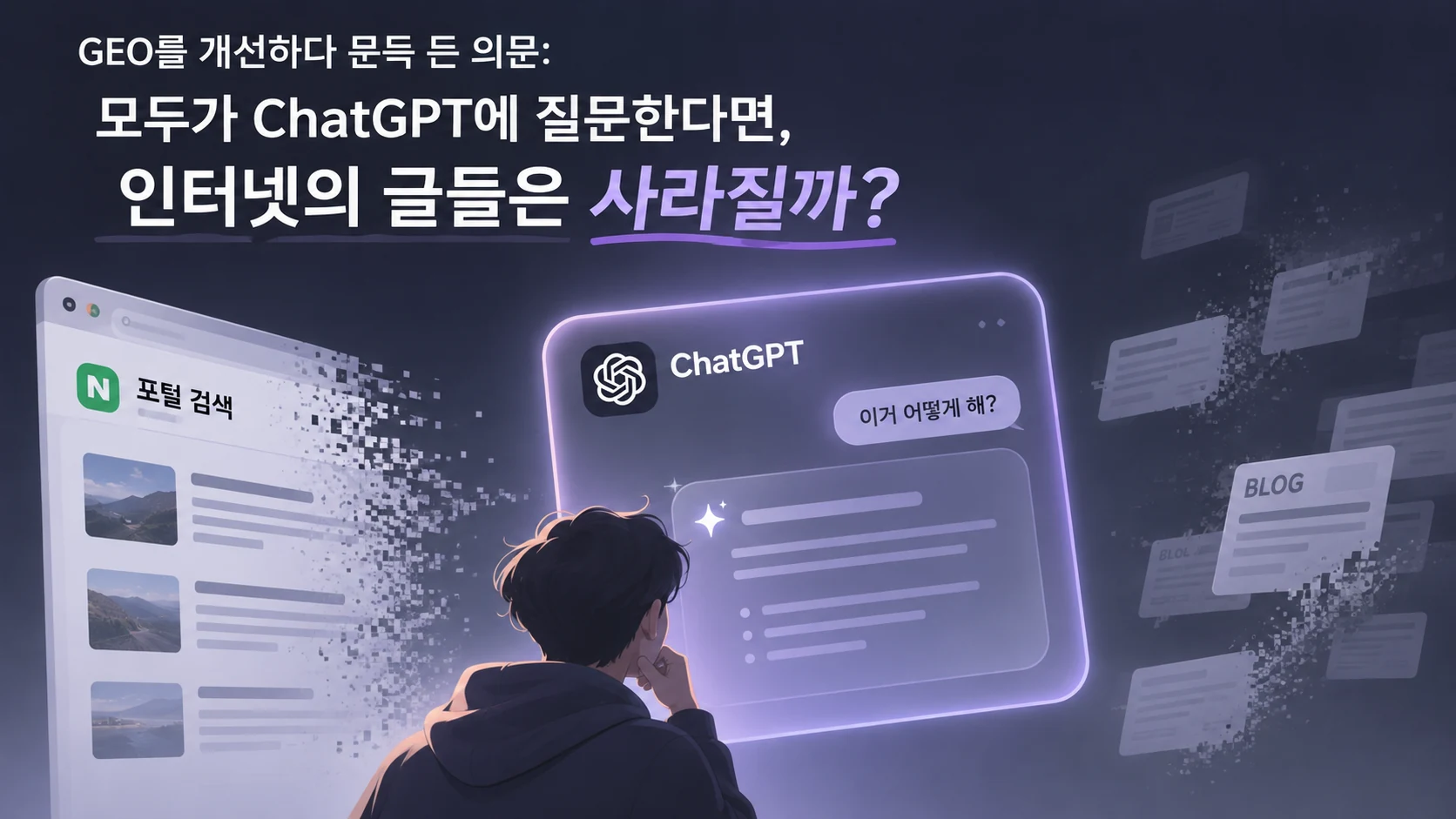
A thought suddenly occurred to me while working on GEO improvements at my company.
My job is to help our service appear when people ask AI questions. But does that mean fewer people will find our site by Googling in the future?
GEO stands for Generative Engine Optimization. It means improving how well AI can find and use information about our service when generating answers. Think of it as helping people discover our service in AI answers as well as search results.
When I got stuck while developing, I used to search Google and read the articles in the results for a solution. The good people of Stack Overflow helped me especially often. I also wrote regularly on Velog because I wanted to share my own trial and error.
Since ChatGPT came along, I’ve found myself visiting Stack Overflow less and less. Even for everyday searches, I now ask AI first instead of looking through Naver blogs or Google results.
If more people are like me, fewer people will visit sites through search. Fewer visitors can mean fewer ad impressions and less revenue. For people who wrote in the hope of getting traffic and earning money, the motivation to write the next post might weaken too.
Someone writes, people visit and read, and the response and revenue lead them to write again. If that cycle weakens, who will produce the new writing that AI reads in the future?
As someone who used to be an active blogger, I started wondering.
If people stop writing new posts, what will AI learn from to become smarter? Or will it be so smart by then that it no longer needs new training?
Will the ecosystem connecting advertising, content, and search engines enter a new paradigm too?
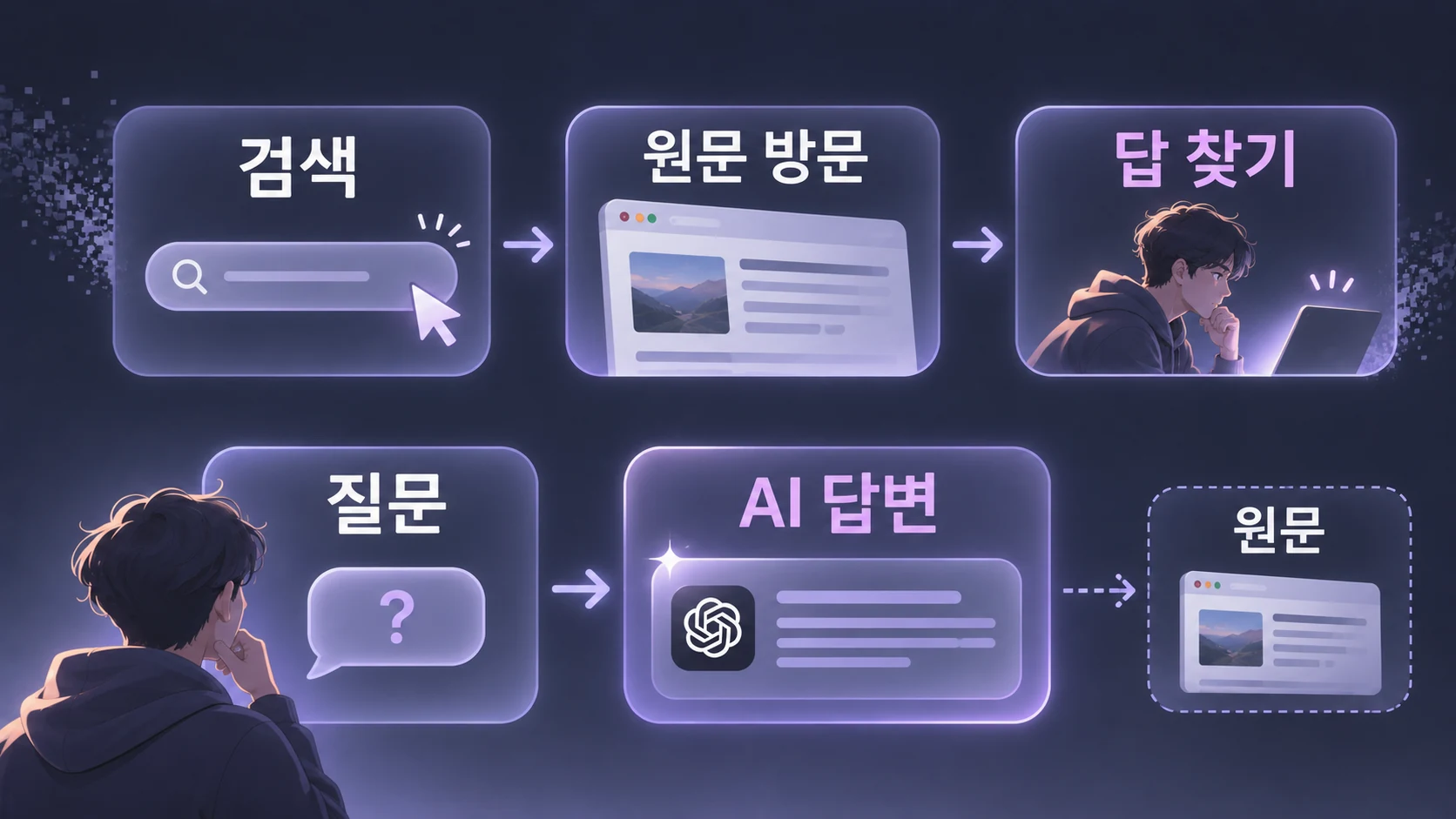
First study: do people who read AI answers click the source links?
First, I wanted to know whether visits to original sources were actually declining.
Pew Research Center analyzed the March 2025 browsing records of 900 U.S. adults. When people visited Google search pages with AI summaries, they clicked a traditional search result link 8% of the time. On pages without AI summaries, that figure was 15%. Links inside the summaries were clicked 1% of the time. Pew Research Center, 2025
The study did not randomly assign whether users saw an AI summary. Search intent and question length could differ, and another limitation was that search results were collected again after the actual browsing took place. Under those conditions, searches with AI summaries were observed to have lower click rates. Methodology
Simply displaying a source didn’t guarantee a visit to the original. If the answer already resolves your question, it makes sense that you’d have less reason to click. I’m like that myself.
Second study: after people start asking AI, do public questions and answers decrease too?
Imagine posting a question on Stack Overflow after encountering an error while coding. Someone offers a solution, and someone else comments that it doesn’t work in a particular version. New answers may appear over time.
While the questioner’s problem is being solved, a page is also being created for the next person to find through search. If the same problem is solved in a private conversation with AI, that process may remain inside the conversation.
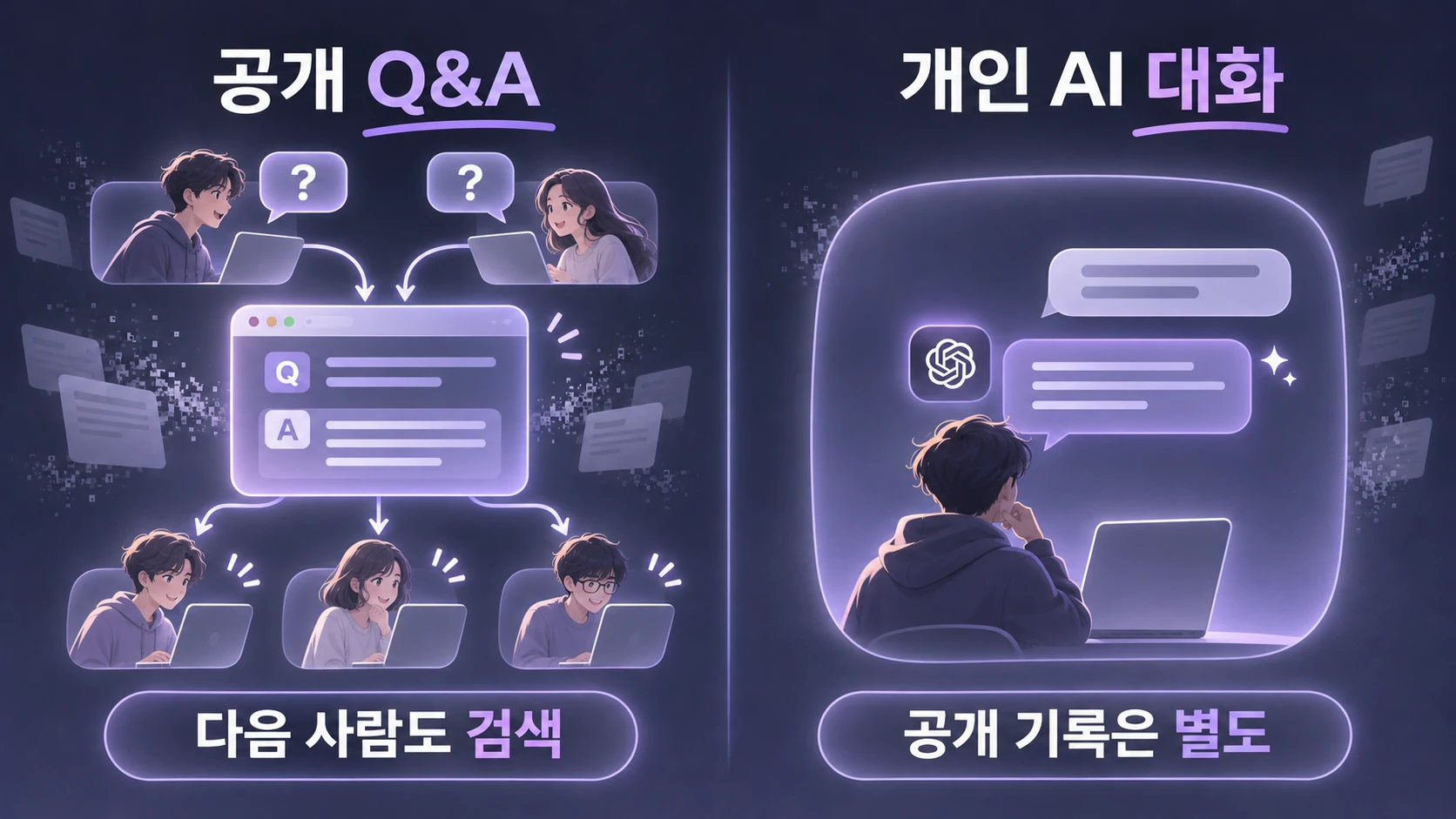
“Large language models reduce public knowledge sharing on online Q&A platforms,” published in PNAS Nexus in 2024, analyzed this change.
The researchers compared posting activity on Stack Overflow with other Q&A platforms where ChatGPT was relatively less accessible or less able to substitute for the platform at the time. They estimated that, six months after ChatGPT’s release, question-and-answer posting activity had fallen by around 25% relative to the comparison platforms. Declines appeared across user groups, from beginners to experienced contributors. del Rio-Chanona et al., 2024
As the places people obtained information changed, their behavior in leaving new information in public spaces was changing too.
Then what if, while AI uses the answers people have left behind, new questions and answers on Stack Overflow decrease, and one day the site itself disappears? What would AI learn from next?
Is Stack Overflow still operating?
I looked it up, and Stack Overflow was still operating. Alongside maintaining its public Q&A, it was providing data to AI companies and running a business that manages knowledge within companies.
In 2024, it announced an API partnership with OpenAI to use Stack Overflow questions and answers in OpenAI products with attribution. It also continues to run a licensing service providing data for AI training, search, and other uses. Partnership announcement · Stack Data Licensing
In 2026, it also announced a new version of Stack Internal, which helps people and AI use knowledge scattered across company documents and conversations. Stack Internal announcement
This shifted my initial expectations a little.
Even if fewer people visit a site directly, the information accumulated there can continue to be used through AI. There were also efforts to turn that use into a business.
Still, a successful business supplying existing data and people continuing to contribute new answers are issues we need to consider together. Old answers alone cannot keep explaining newly released technologies and new errors.
Baekjoon closed, then reopened
I also thought of the news that Baekjoon was shutting down.
Baekjoon closed on April 28, 2026. The notice at the time said it had been run by one person for 16 years and that various changing circumstances had led to the decision. A later notice clarified that interpretations of the reasons for closing were speculation, and that the operator had begun considering it several years earlier. Closure notice · Additional notice
There was also a web scraping notice before the closure. It said automated data collection requests had become so excessive that using the site was difficult. This notice shows that automated collection burdened operations. It does not establish who collected the data or why. Web scraping notice
Baekjoon then reopened on November 20 under Day1 Company’s operation. Its homepage and discussion boards are now running too. Reopening notice
This case made me think about what it takes to sustain a place where resources accumulate. Creating problems, maintaining the judging environment, responding to user inquiries, and operating servers all have to continue. I’d naturally assumed that a site I’d used for years would still exist in the future, but behind it was someone keeping it running.
Where are search engines and advertising heading?
My initial concern had focused only on content creators. But search engines were also changing how they delivered information inside their own services.
Google introduced AI Overviews and AI Mode into search and is expanding advertising within AI Mode too. In an October 2026 announcement, it said AI Mode ads would expand to more countries, and that ads in follow-up questions would be introduced in the U.S. Google’s AI Mode advertising announcement
This suggests that where ads appear may change too. Users can discover products and services and encounter ads inside AI answers before visiting individual sites.
If so, advertising revenue generated within a search service and advertising revenue generated after visits to outside sites could move differently. It occurred to me that even as AI search usage grows, the visits and revenue original authors hope for might not increase.
Information providers were trying new approaches too. Cloudflare’s Pay Per Crawl lets site operators set a price for AI crawlers to access their pages. It is an attempt to charge those collecting information for access, alongside the existing model of visitors viewing ads. Cloudflare documentation
Stack Overflow’s data licensing is connected to this change too. It seeks to earn value by providing accumulated information to AI.
Still, I don’t think these models will offer every blog the same opportunity. Sites with large collections of resources and operating teams have different circumstances from individual blogs when negotiating contracts or managing data. This is my own expectation based on the examples above.
I should therefore evaluate GEO outcomes a little differently too. Whether AI mentions our service, whether that leads to a visit, and whether the visit turns into an inquiry or purchase all need to be checked separately.
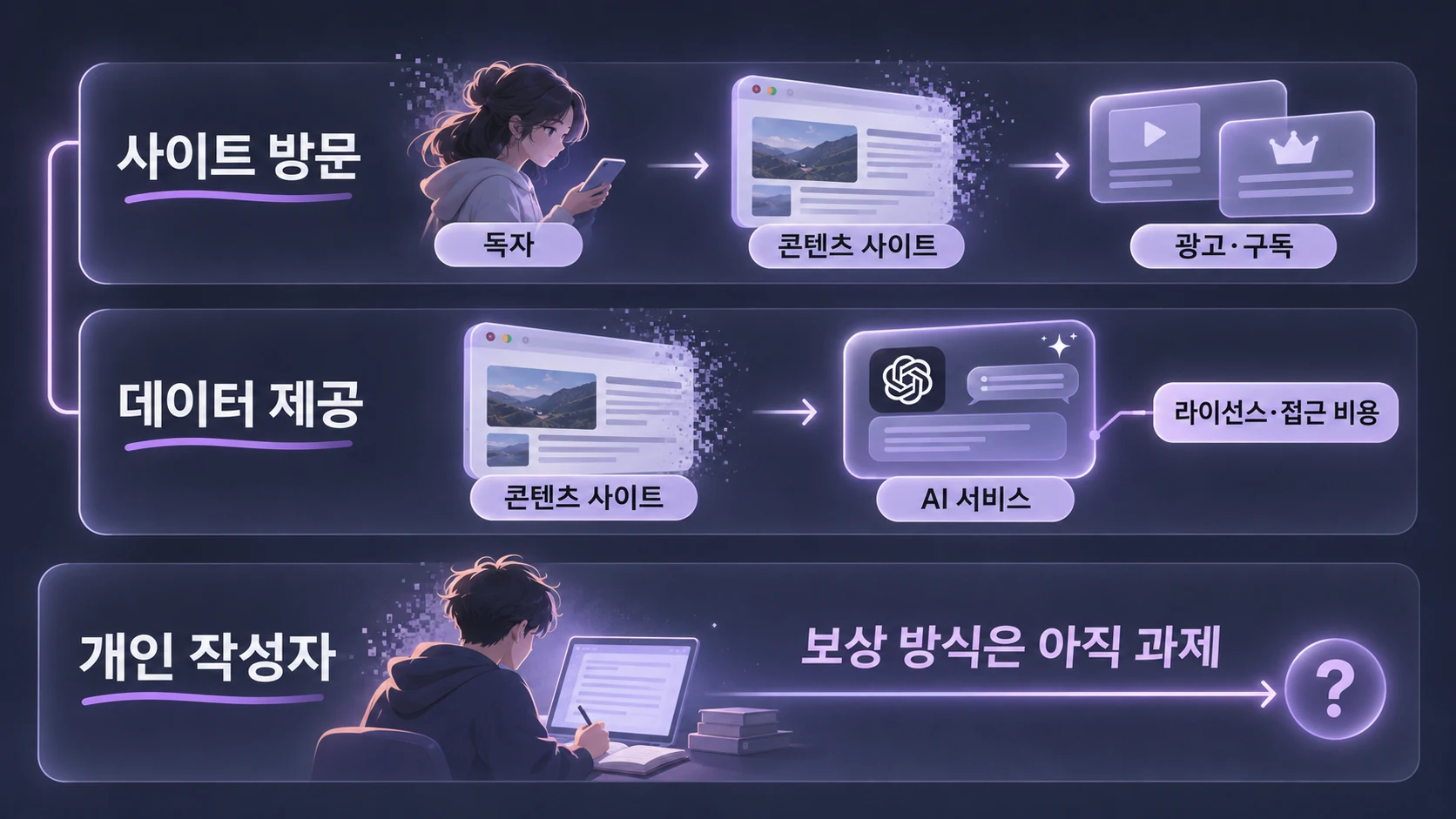
The image above is a simplified conceptual diagram of content use and compensation. Actual contract terms and availability differ by service.
Couldn’t AI just keep learning from AI-written content?
At this point, my original question came back to me. Even if people write less, couldn’t AI create material to fill the gap?
Shumailov and colleagues’ 2024 Nature paper analyzed how information can be lost and errors can accumulate when data generated by one AI is repeatedly used to train the next. Less common material is missed first, and repetition can eventually prevent the model from properly reflecting the original data. This is called model collapse. Shumailov et al., 2024
That didn’t mean synthetic data always worsens performance. Another study avoided model collapse in its experiments by retaining the original data while adding AI-generated material. Gerstgrasser et al., 2024
This means methods for preserving and verifying existing material matter. But even well-preserved old posts won’t contain the solution to an error that happened for the first time today. We still need ways to acquire new experience.
RAG allows external documents to be retrieved and new information to be used in answers. But someone still needs to put information into those documents. Lewis et al., 2020
There are also ways for AI to create its own material. AlphaGeometry improved its problem-solving ability using synthetic geometry data and a mathematical reasoning system. It is an example from a domain where generated results can be verified against rules. Trinh et al., 2024
In the future, AI may obtain more information directly by executing code and conducting experiments. Still, knowing how reality has changed requires a way to observe it. People’s reactions to a new feature or incidents during operation can only be checked with access to those situations.
Changes in the search and content ecosystem
Even as AI becomes smarter, it still needs new information. It can learn from synthetic data and directly verified results, but understanding new events in the real world requires observation and experience.
Search engines and content sites are changing how they use that information and earn revenue from it. Search engines put ads into AI answers, while Stack Overflow runs a business supplying accumulated knowledge to AI. Google AI Mode ads · Stack Overflow data licensing
In the future, alongside people visiting sites to read, AI retrieving and using information may become a source of revenue. Whether this change will also give individual bloggers a reason and an income to keep writing remains uncertain.