If you’re a frontend developer using React, you’ve probably used styled-components quite a bit. I’ve used it alongside React too, and recently I’ve been using Emotion more often because of its better performance and simpler handling of props.
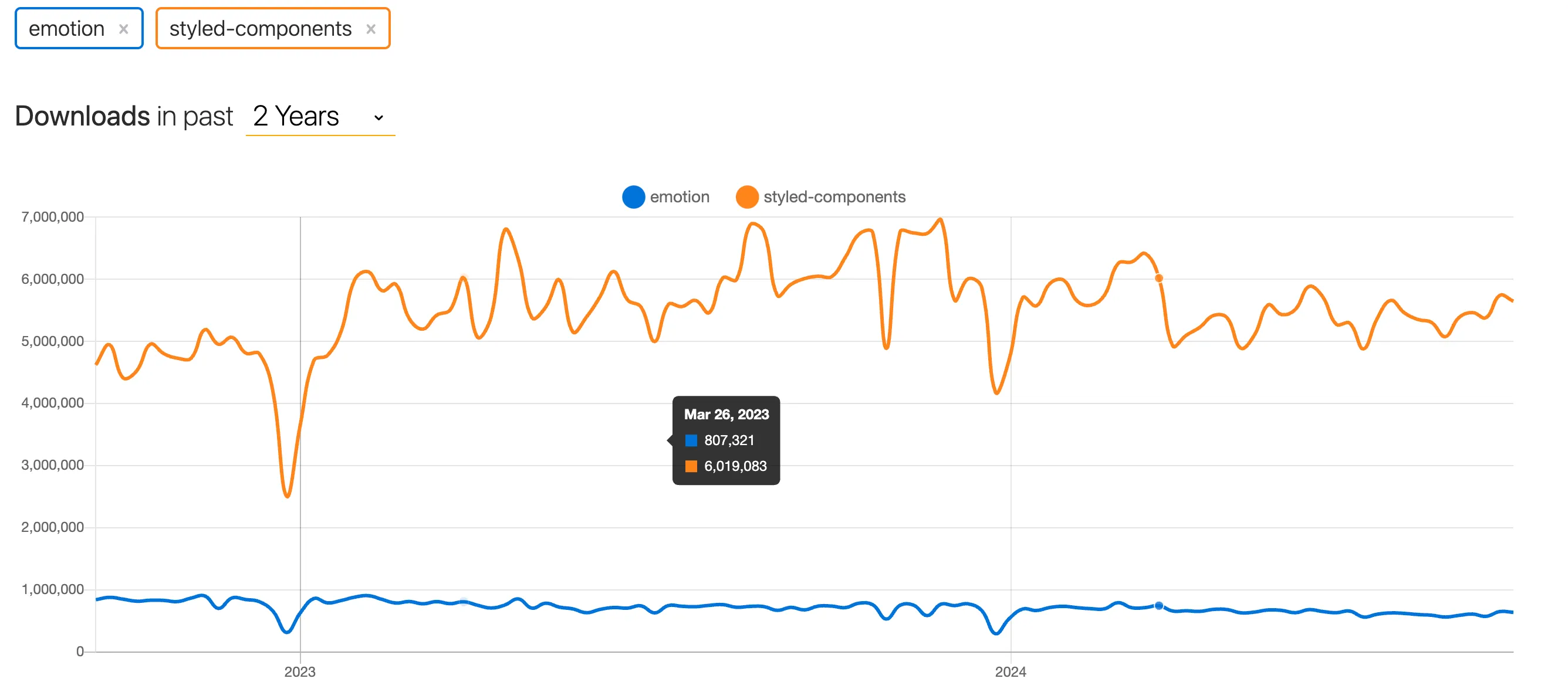
I’ve been taking it for granted, so let’s revisit why we use CSS-in-JS.
How CSS-in-JS Emerged
- The rise of component-based architecture:
- Frameworks such as React, Vue, and Angular encouraged component-based development.
- Traditional CSS struggled to fully support component independence and reuse.
- The global namespace problem:
- Traditional CSS uses a global namespace, making style conflicts common.
- Large applications required complex naming conventions to avoid collisions.
- The need for dynamic styling:
- As web applications became more dynamic and interactive, the need to change styles dynamically at runtime grew.
- Changing styles based on JavaScript state was cumbersome with traditional CSS.
- Performance optimization:
- Removing unused CSS from large applications was difficult.
- There was demand to reduce initial loading times by loading only the styles needed.
- Better maintainability:
- Managing CSS and JavaScript files separately added complexity to large projects.
- Developers wanted to keep all component-related code (HTML, JS, and CSS) together.
- Limitations of CSS preprocessors:
- Preprocessors such as Sass and Less solved many problems, but still couldn’t fully address dynamic styling and component isolation.
- Drawing on JavaScript’s capabilities:
- Developers wanted to use JavaScript’s rich features and ecosystem for styling too.
- Conditions, loops, and functions could be used directly in styles.
- Type safety:
- As TypeScript became more popular, demand grew for type checking in CSS as well.
CSS-in-JS emerged as an attempt to solve these problems. Since Facebook’s Christopher Chedeau (vjeux) introduced the concept in his 2014 talk “React: CSS in JS,” a variety of CSS-in-JS libraries have been developed.
However, not every library satisfies every requirement. Some of these things are also possible with traditional CSS.
Because I use a component-based architecture, I find CSS-in-JS more readable and efficient than traditional CSS.
Drawbacks of CSS-in-JS
While researching its origins, I came across an article called “Why We’re Breaking Up with CSS-in-JS.” https://junghan92.medium.com/%EB%B2%88%EC%97%AD-%EC%9A%B0%EB%A6%AC%EA%B0%80-css-in-js%EC%99%80-%ED%97%A4%EC%96%B4%EC%A7%80%EB%8A%94-%EC%9D%B4%EC%9C%A0-a2e726d6ace6
These are some of its shortcomings.
- CSS-in-JS adds runtime overhead. When a component renders, the library has to serialize styles into plain CSS that can be inserted into the document. This takes extra CPU time.
- CSS-in-JS increases bundle size. Visitors need to download JavaScript for the CSS-in-JS library. Emotion is 7.9 kB compressed, and styled-components is 12.7 kB.
- There are many more things that can go wrong with CSS-in-JS, especially with SSR and/or component libraries. The Emotion GitHub repository receives numerous issue reports of this kind.
A newer library emerged to address these issues: Vanilla Extract. Since runtime CSS causes significant issues with SSR, compile-time CSS-in-JS libraries appeared. We need to compare the strengths and weaknesses of these libraries and choose one that suits the project.
References https://ttaerrim.tistory.com/64 https://shiwoo.dev/posts/next-13-and-css-in-js